
The Doppler Effect
How an everyday phenomenon help astronomers.

Imagine standing on a sidewalk watching an ambulance drive past. As the ambulance approaches, you may notice that the siren becomes increasingly high pitch, and as it passes you and drives further away, the siren’s pitch starts to decreases again. This is the doppler effect.
How the Doppler Effect help astronomers
The doppler effect is named after Austrian physicist Christian Doppler, who in 1842 described the phenomenon mentioned above. It is attributed to the changes in frequency of a wave in relation to an observer. Recalling the earlier paragraphs, the reason you hear a higher pitch when an ambulance drives towards you is because the frequency of the wave increases.
While this may be an interesting phenomenon, how does it help astronomers exactly? As it turns out quite a fair bit. Most of us may be familiar with the electromagnetic spectrum, which tells us that visible light is in fact a type of wave with wave-like properties such as frequency and wavelength. In that sense, light is actually similar to sound.
Astronomers use this fact to help them determine the expansion of the universe. The concept behind it is actually astonishingly simple. By first finding out the specific elements in distant stars, astronomers have a baseline to compare the actual spectral lines1 and the predicted ones. If the spectral lines detected have a higher wavelength than expected (red-shifted) , it can be deduced that the object is moving away. Likewise, a shorter than expected wavelength (blue-shifted) implies the object is approaching.
Determining the speed of the universe expansion
Apart from telling us whether something is moving closer to or further away from earth, the red-shift (and blue-shift) also help scientist determine the velocity of the object relative to earth. While the math behind it is too complicated for the average person to understand, the concept behind it is much easier to comprehend. It follows the logic that the larger the shift in wavelengths, the faster the speed.2
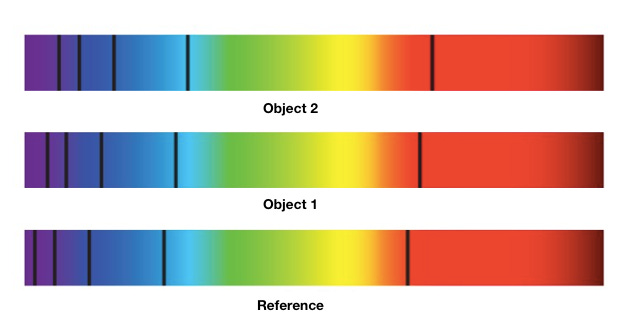
Take for instance two objects, 1 and 2, both of the same material. Both objects have wavelengths that are red-shifted (when compared to reference). This tells us that they are both moving away. However, object 2 has a larger shift than object 1, implying that object 2 is moving faster (and further) away from earth.
Spectral lines are sort of a ‘chemical fingerprint’ for elements. Each elements have different spectral lines.
It is important to note that the formula assumes obedience of Hubble’s Law which states that galaxies are moving away from earth at speeds proportional to their distance.